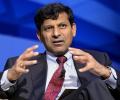
Former Reserve Bank Governor Raghuram Rajan said India will still remain a lower middle country if the potential growth rate remains at 6 per cent annually without any rise in population by 2047 (Amrit Kaal) and will be reaching the end of the demographic dividend by then. Speaking at a programme organised by Manthanon on Saturday, the economist said if the country does not grow faster, it will grow older (demographically) before it gets richer, which means there is the burden of an aging population to deal with also at that point. Rajan said the GDP growth in India for the past two quarters was in the region of 7.5 per cent and if one looks at the labor force participation, it is very low and when it comes to female participation, "it is the lowest in the G20".

'The impact of economic shocks on the labour markets is usually on the young who delay their entry in response to a fall in job opportunities,' says Mahesh Vyas.
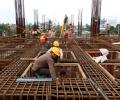
It would be larger than even in the pandemic year of 2020-2021, notes Mahesh Vyas.

Neither the CAA nor the proposed NRC are important enough to stake the well-being of so many or stake economic growth. Getting growth back on track is more important, notes Mahesh Vyas.

Rural and urban regions present different labour participation and employment levels. These differences also are not tuned to India exploiting its demographic dividend, says Mahesh Vyas.

While overall employment rose from 456 mn to 463 mn between FY11 and FY15, with farm employment falling by 26 mn over the same period, the net addition to employment over the entire four year period was a mere 7 mn.

'Over the next 20 years, we would be adding almost 10 million people to the workforce every year!' 'And we won't be able to give employment to even 2 million out of the 10 million every year.' 'Don't forget, it keeps adding every year.'

The recovery seen in the increased economic activity till September or October is running out of steam. Labour statistics indicate a substantial slowing down of the economy in November, notes Mahesh Vyas.

Amid fears of a third wave of coronavirus pandemic and hardening of retail inflation, the Reserve Bank is likely to maintain status quo on interest rate and watch the developing macroeconomic situation for some more time before taking any decisive action on monetary policy. The RBI is scheduled to announce its bi-monthly monetary policy review on August 6 at the end of the three-day meeting -- August 4-6 -- of the Monetary Policy Committee (MPC). The RBI Governor-headed six-member MPC decides on the key policy rates.

The second wave of COVID-19 and the resultant localised lockdowns have impacted over 75 lakh jobs, taking the unemployment rate to a four-month high of 8 per cent, the Centre for Monitoring Indian Economy (CMIE) said on Monday. The situation on the employment front is expected to continue to remain challenging going forward as well, CMIE's managing director and chief executive Mahesh Vyas said.

The loss of job opportunities in recent times has been so severe that labour stopped even looking for jobs, says Mahesh Vyas.

The fall in the employment rate translated into a 2.6 million fall in absolute employment between December 2022 and March 2023. Most of this fall was in March 2023.

The administration has introduced 'Maidan Cup' in collaboration with the Mann Deshi Foundation and Sachin Tendulkar Foundation, under which 50 playgrounds will be developed in Dantewada to boost sports culture and talent.
Rising unemployment rate reflects a rise in the labour participation rate, which in India's case has been worryingly low.

'When you do some job for a few hours, you are hardly earning enough to survive.'

According to the World Bank, economic growth in middle-income countries, including India, is not accelerating. 'In fact, it is slowing down as incomes increase, with the trend becoming more pronounced each decade.'

'The rise in unemployment, underemployment, discouraged workers and job insecurity is likely to continue, with very adverse consequences for the nation's economic well-being and social cohesion,' warns Shankar Acharya.

A report stated that despite initial setbacks from demonetisation and Goods and Services Tax, "all in all" the Indian economy has done well.

Users of employment / unemployment statistics can enjoy the benefits of -- initially the speed of private enterprise and then, the stamp of official statistics with a hopefully small time lag, says Mahesh Vyas.

It will be interesting to see what shifts have been recorded in the last decade-and-a-half -- from the effects of demonetisation and Covid's second wave to the drop in fertility and increase in farm workers -- but we will only know this if and when the Census is conducted, points out Aakar Patel.
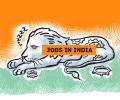
The problem of unemployment is spread across the economy.

'As the global economy undergoes significant transformations in 2025, India's ability to navigate the complexities of trade wars, financial realignments, and emerging blocs will be pivotal,' explain Harsh V Pant and Soumya Bhowmik.

The markets, at this point, have rallied on the view that the Fed will not budge from the zero-bound as long as inflation remains subdued

The substantially increased economic dualism may exert lasting negative influences which could include a reduced potential for economic growth; the persistence of a very weak employment and poverty situation; rising social and political discord; and heightened vulnerability to geopolitical challenges, cautions Shankar Acharya, former chief economic adviser to the Government of India.

The economy faces more downside risks now as economic disruptions arising from the second wave are likely to stabilise only from July, warned the Swiss brokerage USB Securities. Last month, the brokerage had cut its GDP forecast by 150 bps to 10 per cent for FY22, which though is much higher than the consensus projections by others with some pegging it at as low as 8 per cent. Though adverse impacts on sequential growth is less severe than in the June 2020 quarter when it plunged by 23.9 per cent, as lockdowns are more targeted and localised and households and businesses have adjusted to the new normal now, still, it is increasingly possible that normalcy returns only by July as against our baseline assumption of June.

India has the lowest labour force participation rate in South Asia and one of the lowest in the world, points out Aakar Patel.

'Karnataka's finances are much healthier than the Union government's, which is indebted to nearly twice the extent of the state.'
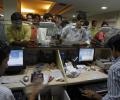
Through the past few decades, India has been transformed from a largely agriculturally-oriented economy to one in which the services sector accounts for an overwhelming share of gross domestic product (GDP).

It is necessary that at least three million additional jobs (if not more) are created every year to ensure that there isn't an increase in the stock of unemployed, says Mahesh Vyas.

Get more people working, get more people working in modern manufacturing and services in our cities, and get people working better and longer, suggests Naushad Forbes, past president, CII.

Business activity has fallen by a fourth of the pre-COVID levels due to lockdowns imposed by states to contain the spread of the second wave of COVID-19, Japanese brokerage Nomura said on Tuesday. However, it said the falling activity levels will have a muted economic impact and maintained its growth estimates for the year, saying the lockdowns present "downside risks". As of April 25, the Nomura India Business Resumption Index (NIBRI) registered its steepest weekly fall in over a year of 8.5 percentage points to 75.9, which is 24 percentage points below pre-pandemic normal, the brokerage said in a statement.

The cumulative loss of salaried jobs since the pandemic is even larger at 12.6 million, reveals Mahesh Vyas.
The Survey noted that while women account for almost half of India's population, their participation in labour market is almost one-third and has been declining.

After assuming power in 2014 with a full majority of its own, the BJP-led NDA government started an ambitious process of reforming labour laws in the form of codes aimed at making the framework less cumbersome with a variety of alterations. It had planned four codes each for industrial relations, wages, social security and welfare, and occupational safety, health and working conditions. To this end, 35 central labour laws were to be converted into four codes that would have had the virtue of streamlining labour relations. But none of the proposed code Bills could be converted into a law principally because neither trade unions nor industry representatives came on board. They hold the key to India's low-growth-high unemployment paradigm but the government may struggle to push them through this time as well. Somesh Jha explains why

'Over 27 million youngsters in their 20s lost their jobs in April.' '33 million men and women in their 30s lost jobs in April,' points out Mahesh Vyas.

In the past 12 months, since September 2020, the net cumulative increase in employment has been just 44,483. This is negligible -- just 0.04 million on a base of over 400 million jobs, reveals Mahesh Vyas.

'The government should come back as a job creator as it did in the 1960s and the 1970s.'

Growing at a robust rate due to economic reforms in key sectors like digitisation and infrastructure, India has emerged as a star performer and is projected to contribute more than 16 per cent of the global growth, the International Monetary Fund said on Monday. "What we have been observing for quite some time now is that India has been growing at a very robust rate. "It's one of the star performers when it comes to real growth when you look at peer countries.
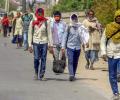
The count of the unemployed mounted to 38.7 million in December 2020 compared to 27.4 million in November, registering a massive increase of 11.3 million, reveals Mahesh Vyas.

India has the best hiring outlook globally, second only to Brazil, with 54 per cent of companies surveyed planning to hire in the December quarter as against 51 per cent in the September quarter, according to a report by global staffing firm ManpowerGroup. The report titled "ManpowerGroup Employment Outlook Survey" showed that India has the strongest net employment outlook for the December quarter in the Asia-Pacific region, followed by China (46 per cent), and Australia (38 per cent). The global net employment outlook in the December quarter would stand at 30 per cent, down by three percentage points from the June-September quarter, yet six percentage points higher than the same period last year, the staffing firm said.
